Enhancing Visual Communication with the Infographic 3D Illustration Pack
In the rapidly evolving landscape of digital communication, the ability to convey complex information quickly and engagingly is paramount. Whether you are a business owner preparing for a quarterly review, a designer crafting a new user interface, or a marketer developing a social media campaign, the visual elements you choose can make or break your message. This is where the Infographic 3D Illustration Pack emerges as a vital resource. It is not merely a collection of images; it is a comprehensive toolkit designed to elevate the aesthetic and functional quality of your visual projects. By integrating high-quality three-dimensional assets into your workflow, you can transform mundane data presentations into captivating visual stories that resonate with your audience.
The Shift Toward Three-Dimensional Design
For years, flat design dominated the digital space, offering clarity and simplicity. However, as screens have become higher resolution and users have grown accustomed to more immersive digital experiences, there has been a noticeable shift toward depth, texture, and realism. Three-dimensional illustrations provide a sense of tangibility that two-dimensional graphics often lack. They allow viewers to perceive scale, perspective, and spatial relationships, which is particularly useful when explaining abstract concepts or demonstrating product features.
The Infographic 3D Illustration Pack capitalizes on this trend by providing ready-to-use assets that embody modern design principles. These illustrations are crafted to be versatile, ensuring they fit seamlessly into various contexts, from corporate presentations to creative web banners. The use of 3D elements helps to break the monotony of text-heavy content, guiding the viewer’s eye and improving information retention. When you incorporate these elements into your work, you are not just decorating; you are enhancing the cognitive ease with which your audience processes information.
Comprehensive File Compatibility and Flexibility
One of the most significant challenges designers face when adopting new asset packs is compatibility. A beautiful illustration is of little use if it cannot be integrated into your existing workflow. The Infographic 3D Illustration Pack addresses this concern by offering a diverse range of file formats, ensuring that professionals across different disciplines can utilize the assets effectively.
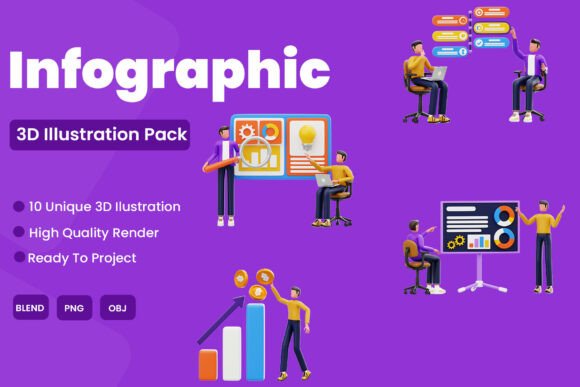
- Blender Files: For 3D artists and designers who require full control over the assets, the pack includes 10 native Blender files. This allows for extensive customization, including lighting adjustments, camera angle changes, and material modifications.
- High-Resolution PNGs: For those who prefer a plug-and-play approach, the pack provides 10 high-resolution PNG images. These are rendered at 3000x2000 pixels, ensuring crisp quality even on large displays or in print.
- Software Compatibility: The assets are optimized for use with industry-standard software such as Adobe Photoshop, Blender, and Illustrator. This broad compatibility ensures that whether you are a vector specialist or a raster editor, you can incorporate these illustrations without technical hurdles.
This flexibility is crucial for teams with mixed skill sets. A marketing manager might use the PNGs for a quick PowerPoint slide, while a senior UI/UX designer might import the Blender files to create interactive prototypes. The versatility of the file types ensures that the pack serves as a unified resource for entire organizations, rather than just individual creators.
Ideal Applications for Modern Professionals
The utility of the Infographic 3D Illustration Pack extends far beyond simple decoration. Its design is specifically tailored for scenarios where clarity and engagement are critical. Below are several key areas where these assets can significantly enhance your output.
Corporate Presentations and Seminars
In the boardroom or at a conference, attention spans are short. Traditional bullet-point slides often fail to capture interest. By integrating 3D illustrations into your presentation decks, you can visualize data trends, organizational structures, or process flows in a way that is immediately understandable. For instance, instead of listing steps in a supply chain, you can use a 3D rendering to show the physical movement of goods. This makes the Infographic 3D Illustration Pack an invaluable tool for consultants, executives, and educators who need to communicate complex ideas efficiently.
Website and UI/UX Design
User experience (UX) design is heavily reliant on visual cues. A website that feels sterile or outdated can increase bounce rates. Incorporating 3D elements into your UI can add depth and interactivity, making the browsing experience more enjoyable. These illustrations can serve as hero images, feature highlights, or empty-state graphics. Because the images are high-resolution, they maintain their integrity across various device sizes, from mobile phones to desktop monitors. Designers can use these assets to create a cohesive visual language that aligns with modern web aesthetics, thereby improving user engagement and time-on-site metrics.
Marketing Materials: Banners and Posters
In the crowded digital advertising space, standing out is essential. Banners and posters created with generic stock photos often blend into the background. The unique style of the Infographic 3D Illustration Pack offers a distinctive look that can help your brand appear more innovative and professional. Whether you are designing a LinkedIn banner, a trade show poster, or an email header, these 3D elements provide a polished finish that draws the eye. The clean, modern aesthetic of the illustrations ensures that they complement rather than overpower your textual content, maintaining a balance between form and function.
Evaluating Suitability for Your Projects
While the benefits of using 3D illustrations are clear, it is important to assess whether this specific pack aligns with your project requirements. Not every design scenario calls for three-dimensional elements. Here are some considerations to help you determine if the Infographic 3D Illustration Pack is the right choice for your needs.
- Brand Identity: Does your brand voice align with a modern, tech-forward aesthetic? 3D illustrations often convey innovation and precision. If your brand is more traditional or rustic, these assets might require significant customization to fit your visual identity.
- Technical Resources: While the PNG files are easy to use, leveraging the Blender files requires a certain level of technical proficiency. If your team lacks 3D modeling skills, you may be limited to using the pre-rendered images. However, for most standard applications, the PNGs are sufficient.
- Project Scope: For large-scale campaigns, having access to source files (Blender) is advantageous as it allows for consistent styling across multiple assets. For one-off projects, the high-resolution PNGs offer a cost-effective and time-efficient solution.
It is also worth noting the limitations. Since the pack contains a fixed number of assets (10 Blender files and 10 PNGs), it is best suited for projects that do not require a vast library of unique characters or scenes. Instead, it excels in providing high-quality, generic business and infographic elements that can be repurposed creatively. The value lies in the quality and resolution of the assets, rather than sheer quantity.
Maximizing Value Through Strategic Use
To get the most out of the Infographic 3D Illustration Pack, consider how these elements can be combined with other design components. For example, pairing a 3D chart with minimalistic typography can create a striking contrast that emphasizes the data. Similarly, using the 3D objects as focal points in a white-space-heavy layout can guide the viewer’s attention effectively.
Furthermore, because the images are rendered at 3000x2000 pixels, they are suitable for both digital and print media. This dual usability adds significant value, allowing you to maintain visual consistency across online ads and printed brochures. When using these assets in print, ensure that your color settings are adjusted for CMYK if necessary, although the high resolution ensures that detail is preserved regardless of the output medium.
In conclusion, the Infographic 3D Illustration Pack represents a practical investment for anyone looking to upgrade their visual communication strategy. It bridges the gap between complex 3D design and everyday usability, offering tools that are both powerful and accessible. By understanding its features, compatibility, and ideal applications, you can leverage these assets to create more engaging, professional, and effective designs. Whether you are decorating a UI, preparing for a seminar, or designing a banner, this pack provides the foundational elements needed to stand out in a visually saturated world.
For those interested in exploring how these assets can transform their next project, reviewing the included files and experimenting with different compositions is the best first step. The ease of integration with Adobe Photoshop, Blender, and Illustrator means that you can start seeing results immediately, enhancing your portfolio and delivering greater value to your clients or stakeholders.